 By Emily Parker
Updated November 2026
Onions and beets companion planting is one of the more practical pairings for a vegetable bed, but finding solid, specific guidance on spacing, timing and pests takes some digging. Readers who want to learn this pairing usually need a reference that covers more than a single line of advice: how to lay out a bed, when to sow, which neighbors to avoid, and how to manage the pests both crops share. This list compares five books that address companion planting in depth, so you can choose the one that matches your garden size, experience level and interest in pest management. The selection criteria were scope (how much of the book covers vegetable pairings in detail), practicality for a home gardener, clarity of guidance on spacing and timing, relevance to US growing conditions, and the consistency of the advice with mainstream extension recommendations.
Best overall: Companion Planting Charts – View on Amazon
Best for small spaces: Companion Planting for Beginners – View on Amazon
Best for US gardeners: Companion Planting for US Gardens – View on Amazon
Best all-in-one reference: The Complete Vegetable Gardener’s Bible – View on Amazon
Best for understanding the science: Carrots Love Tomatoes – View on Amazon
Our Top Picks
Quick Comparison
| Product | Best for | Key feature |
|---|---|---|
| Companion Planting Charts | Quick reference during planning | Chart-style pairing layouts |
| Companion Planting for Beginners | New gardeners with limited space | Beginner-focused pairing guidance |
| Companion Planting for US Gardens | Gardeners in US climate zones | Frost-date calendars and keep-apart lists |
| The Complete Vegetable Gardener’s Bible | Readers who want one broad reference | Covers companion planting alongside pest control and year-round growing |
| Carrots Love Tomatoes | Readers interested in why pairings work | Explains the reasoning behind companion planting |
Companion Planting Charts: 101 Companion Planting Charts for Organic Pest Control, Better Vegetable Pairings, Raised Beds, and Container Gardens
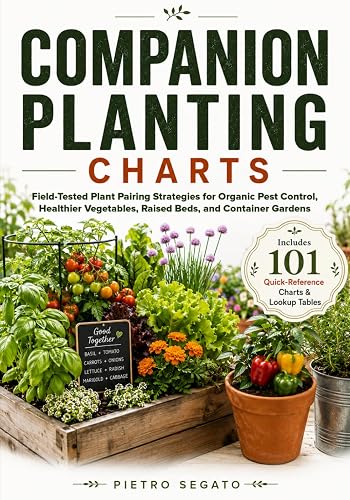
COMPANION PLANTING CHARTS: 101 Companion Planting Charts for Organic Pest Control, Better Vegetable Pairings, Raised Beds, and Container Gardens … for Raised Beds, Containers & Small Spaces)
Best for: Quick reference during planning
This is the right choice for gardeners who prefer visual tools to long narrative chapters. It suits someone laying out a raised bed who wants to check whether onions and beets belong together before sowing, and who wants that check to take seconds rather than minutes. It also fits container gardeners, since the title explicitly covers small-space setups.
Key specs:
- Format: chart-based companion planting reference
- Coverage: raised beds and container gardens, as the title states
- Focus: organic pest control and vegetable pairings
Pros:
- Fast to scan when planning a bed layout
- Covers containers and raised beds, not only in-ground plots
- Pairs well with a written garden plan
Cons:
- Charts summarize rather than explain reasoning in depth
- Less useful for timing questions tied to your specific region
Bottom line: A strong pick for gardeners who want a fast, visual pairing reference for onions and beets and other crops.
Companion Planting for Beginners: Pair Your Plants for a Bountiful, Chemical-Free Vegetable Garden

Companion Planting for Beginners: Pair Your Plants for a Bountiful, Chemical-Free Vegetable Garden
Best for: Small-space beginners
This book is aimed at people who are new to growing vegetables and want to avoid chemical inputs. It is a good fit for a first-season gardener with one or two raised beds who needs to understand why certain crops are planted near each other and how to keep the planting plan simple.
Key specs:
- Audience: beginner vegetable gardeners
- Focus: pairing plants without synthetic chemicals
Pros:
- Written with a beginner’s pace and vocabulary
- Emphasizes chemical-free approaches
- Useful framing for why onions and beets are often grouped in a bed plan
Cons:
- Less depth for experienced gardeners looking for technical detail
- Regional timing guidance may need to be checked against local frost dates
Bottom line: The best starting point for a gardener who is new to pairing vegetables and wants a gentle introduction.
Companion Planting for US Gardens: A US Beginner’s Guide to Vegetable Pairings, Frost-Date Calendars, and Keep-Apart Lists for Small Spaces, With a Garden Log

Companion Planting for US Gardens: A US Beginner's Guide to Vegetable Pairings, Frost-Date Calendars, and Keep-Apart Lists for Small Spaces, With a Garden Log (Small-Space Growing in the US)
Best for: US gardeners who need timing tied to frost dates
Frost-date calendars and a garden log make this the most practical choice for American growers who plan around their last spring frost. It suits someone who wants to sow beets and onions at the right point in the season and track results year over year.
Key specs:
- Region: written for US gardens
- Includes frost-date calendars and keep-apart lists
- Includes a garden log for tracking results
Pros:
- Frost-date planning is directly tied to US growing zones
- Keep-apart lists help avoid poor neighbor combinations
- The garden log supports season-to-season learning
Cons:
- Frost calendars still need to be checked against your local extension office data
- Written for small spaces, so may feel limited for large plots
Bottom line: Ideal for US home gardeners who want a timing-focused guide and a built-in way to record what worked.
The Complete Vegetable Gardener’s Bible [8 Books in 1]: Unlock the Secrets of Companion Planting, Pest Control, and Year-Round Gardening

The Complete Vegetable Gardener's Bible [8 Books in 1]: Unlock the Secrets of Companion Planting, Pest Control, and Year-Round Gardening with The Old … Perfect for Preppers and Novice Gardeners.
Best for: Readers who want one broad reference
This is a large compilation covering many gardening topics, with companion planting as one section. It works for someone who wants a single volume to keep on the shelf for pest control, year-round growing and pairings, including onions and beets.
Key specs:
- Format: multi-book compilation
- Topics: companion planting, pest control, year-round gardening
Pros:
- Broad coverage in one volume
- Useful for gardeners who want more than pairings alone
- Good reference for planning a full growing calendar
Cons:
- Companion planting coverage is spread across many topics, so depth per crop is limited
- Large volume may be more than a small-space gardener needs
Bottom line: Choose this if you want a general gardening reference and onions and beets companion planting is one part of a bigger learning goal.
Carrots Love Tomatoes: Secrets of Companion Planting for Successful Gardening

Carrots Love Tomatoes: Secrets of Companion Planting for Successful Gardening
Best for: Readers interested in why pairings work
This is a well-known companion planting title that focuses on the reasoning behind pairings rather than charts alone. It suits a gardener who wants to understand the mechanisms, so they can adapt the advice when conditions differ from the book’s examples.
Key specs:
- Focus: the principles and reasoning behind companion planting
- Format: narrative guide
Pros:
- Explains why pairings succeed or fail
- Helps gardeners adapt advice to their own beds
- Strong foundation for thinking about any pairing, not just onions and beets
Cons:
- Narrative style means less quick-reference utility during planning
- Some examples may not match US frost timing exactly
Bottom line: The right pick for a reader who wants to understand companion planting principles deeply before applying them to onions and beets.
Buying Guide
Scope and depth of pairing advice
Look for a book that discusses onions and beets specifically, or at least explains the principles that let you judge the pairing yourself. Some references list pairings without reasons, which leaves you stuck when conditions differ from the examples.
Good picks for this: Carrots Love Tomatoes, Companion Planting Charts
Timing and frost-date guidance
Beets are generally sown directly in the garden as soon as the soil can be worked, while onions are often started from sets, transplants or seed earlier. A useful guide should explain how these timings interact with your last spring frost. Confirm dates with your local cooperative extension service.
Good picks for this: Companion Planting for US Gardens, Companion Planting for Beginners
Spacing and layout
Beets typically need about 3 to 4 inches between plants once thinned, and onions generally need 4 inches between bulbs. A good reference will give spacing numbers and bed layout examples, not vague advice.
Good picks for this: Companion Planting Charts, The Complete Vegetable Gardener’s Bible
Pest management
Onions and beets share few major pests, but both can be affected by thrips and leaf miners depending on region. A guide that covers organic pest control and monitoring is more useful than one that only lists pairings.
Good picks for this: Companion Planting for Beginners, The Complete Vegetable Gardener’s Bible
Garden size and format
Match the book to your bed size. Small-space and container gardeners benefit from layouts designed for compact plots, while larger growers may want more detail on rotation and succession.
Good picks for this: Companion Planting for US Gardens, Companion Planting Charts
Depth of explanation
Some readers want a quick chart, others want the underlying reasons. Decide which you need before you buy, since the two approaches serve different purposes.
Good picks for this: Carrots Love Tomatoes, The Complete Vegetable Gardener’s Bible
Record-keeping features
A garden log or planting calendar helps you compare what you planted with what happened. This matters for pairings like onions and beets, where results depend on your soil and weather.
Good picks for this: Companion Planting for US Gardens
FAQ
Do onions and beets grow well together?
Many gardeners plant them in the same bed because they have different root depths and similar moisture needs, though the evidence for strong benefits is mostly anecdotal. Give each crop its proper spacing and watering so neither suffers.
When should I plant beets and onions in the same bed?
Beets are usually direct-sown as soon as the soil can be worked, and onions are often set out earlier. Plan around your local last frost date and check with your regional extension service for exact timing.
How far apart should onions and beets be planted?
Thin beets to about 3 to 4 inches apart and space onions roughly 4 inches apart. Adjust for variety, since larger onion types may need more room.
What should I avoid planting near beets?
Beets are commonly listed as incompatible with pole beans and some other crops in companion charts. Check a reliable reference before pairing beets with any new neighbor.
Can I grow onions and beets in containers?
Yes, both can be grown in containers at least 8 to 12 inches deep, though beets benefit from a deeper pot and consistent watering to prevent woody roots.
Which pests affect onions and beets?
Thrips can affect onions, and leaf miners and flea beetles can affect beets, depending on region. Monitor plants regularly and consult your local extension office for pest identification and control.
Conclusion
For a broad, visual planning tool, Companion Planting Charts is the most direct option. Beginners with limited space should look at Companion Planting for Beginners, while US gardeners who plan around frost dates will get the most from Companion Planting for US Gardens. Readers who want one large reference can choose The Complete Vegetable Gardener’s Bible, and those who want to understand the principles behind onions and beets companion planting should read Carrots Love Tomatoes.
Sources
- Regional vegetable planting guides and pest identification resources from land-grant universities (extension.org)
- Hardiness zone and climate information relevant to planting dates (usda.gov)
- Research on vegetable crop management and integrated pest control (ars.usda.gov)
Before you buy: helpful guides
Related reading
- 6 Best Onions and Potatoes Companion Planting Books and Guides for 2026
- Zucchini and Onion Companion Planting: Steps, Spacing and Pitfalls
- Potato and Onion Companion Planting: Pairings, Spacing and Pitfalls
- Onions and Tomatoes Companion Planting: A Step-by-Step Guide
About Emily Parker
Emily Parker is part of our editorial team and reviews and edits our vegetable & edible gardening guides, checking product details against manufacturer specifications and owner feedback.